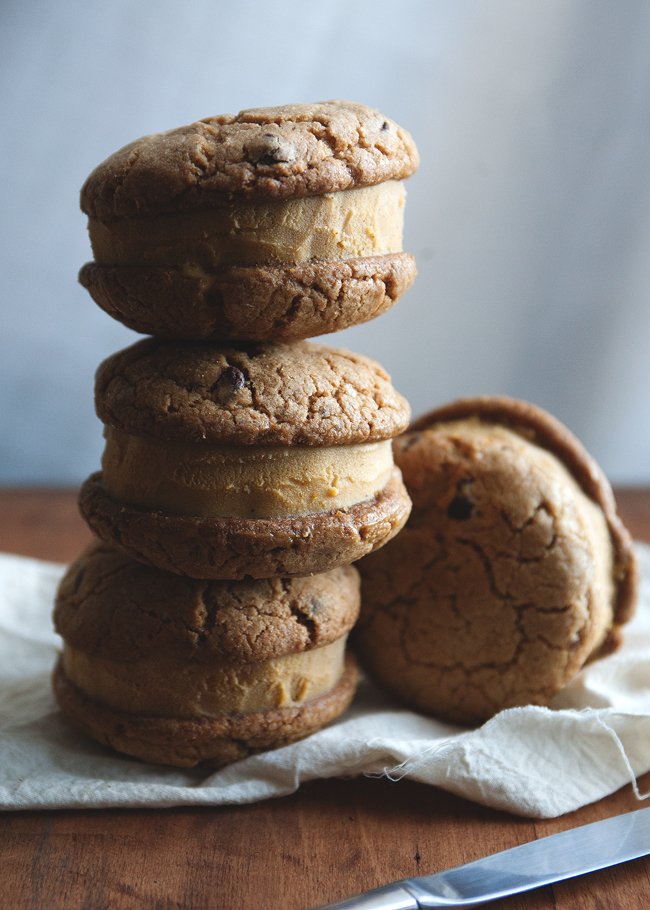
Pumpkin Ice Cream Sandwiches
So, the afternoon before the hurricane struck (sorry, no more talk of hurricanes after this post), I decided to make chocolate chip cookies. I imagined spending a cozy evening nestled on the couch reading by candlelight, drinking tea and nibbling on cookies.
But of course, we ended up not losing our power at all. So there was no need to pull out the candles, we didn’t end up boiling water for tea, and the cookies were ultimately forgotten. (Who forgets about freshly-baked chocolate chip cookies, you might be wondering? Not us, usually.)
The next day, I had the bright idea of making ice cream sandwiches from the cookies, which meant the cookies were off-limits until the pumpkin ice cream had been made. And ice cream-making always turns into a multi-day process, what with the making of the custard, and cooling it, and churning it, and finally freezing it.
All the while, the cookies sat on the counter tempting Chris, whose sweet tooth, though not as legendary as his dad’s (the man has been known to douse his Swedish pancakes with powdered sugar so that the pancake all but disappears), is quite acute. Every time he reached for one, I swatted his hand away. “Stay back,” I snarled.
Before you feel too bad for him, remember that I was making pumpkin ice cream sandwiches. He was going to be rewarded for his patience! I didn’t feel too cruel.

Let me tell you a little bit about the cookies, because they’re actually my favorite chocolate chip cookie recipe ever (no, not the Cook’s Illustrated version I made earlier this year).
The recipe is actually from Kim Boyce’s Good to the Grain, a book I like very much. The cookies are made completely with whole wheat flour, so their texture is much richer and nuttier than cookies made with all-purpose.
They’ve got so much dimensionality and… dare I say it…complexity. I could eat the dough without the chocolate, and it would only be slightly less delicious. That’s saying a lot, since chocolate is usually integral to my enjoyment of any dessert.
I quickly became hooked on baking with whole-grain flours after this cookie (although this pound cake helped a lot, too).

The pumpkin ice cream recipe, on the other hand, I’m not particularly attached to. It does make a decent-tasting batch, however. Not too rich, very pumpkin-y, no complaints at all. But of course, my mind was salivating at the idea of pairing it with the chocolate chip cookies. The two together fulfill some sort of dessert fantasy of mine.
And after the ice cream sandwiches were made, I told Chris to have at them. But of course, he’s barely touched them. I guess his anticipation must’ve soured. Or maybe they’re just too much dessert (he commented that each one was the size of a small burger, haha).
WHOLE WHEAT CHOCOLATE CHIP COOKIES
From Good to the Grain Makes about 12 cookies:
Ingredients:
1-1/2 cups whole wheat flour
3/4 tsp baking powder
1/2 tsp baking soda
3/4 tsp kosher salt
1 stick cold unsalted butter, cut into 1/2″ pieces
1/2 cup dark brown sugar
1/2 cup sugar
1 egg
1 tsp vanilla extract
4 oz. (2/3 cups) bittersweet chocolate chips
Directions:
Preheat oven to 350 degrees. Line a baking sheet with parchment paper.
Sift the whole wheat flour, baking powder, baking soda, and salt into a medium bowl. Add the butter and sugars to the bowl of a standing mixer with a paddle attachment. On low speed, mix just until the butter and sugars are blended, about 2 minutes.
Scrape down the sides of the bowl. Add the egg and mix until combined. Mix in the vanilla. Add the flour mixture and blend on low until barely combined, about 30 seconds. Scrape down the sides and bottom of the bowl.
Add the chocolate all at once and mix on low until evenly distributed. You can also use your hands to incorporate the chips.
Scoop mounds of dough about 2 Tbsp onto the baking sheet. You might want to flatten the dough a bit for a flatter cookie. Bake 16 to 20 minutes, rotating the sheet halfway through, until the cookies are evenly dark brown. Transfer the cookies onto a cooling rack.
PUMPKIN ICE CREAM
Adapted from Williams-Sonoma Ice Cream
Makes 1 quart
Ingredients:
1 cup canned unsweetened pumpkin puree
1 tsp. vanilla extract
1 cup heavy cream
1 cup whole milk
3/4 cup firmly packed dark brown sugar
5 egg yolks
1/2 tsp. ground cinnamon
1/2 tsp. ground ginger
1/4 tsp. salt
Pinch of freshly grated nutmeg
Directions:
In a bowl, whisk together the pumpkin puree and vanilla. Refrigerate.
In a heavy saucepan over medium heat, combine cream, 1/2 cup of the milk, and 1/2 cup of the brown sugar. Cook until bubbles form around the edges of the pan, about 5 minutes. Meanwhile, in a medium bowl, combine the egg yolks, cinnamon, ginger, salt, nutmeg, the remaining 1/2 cup milk, and the remaining 1/4 cup brown sugar. Whisk until smooth, and the sugar begins to dissolve.
Remove the cream mixture from the heat. Temper the egg mixture: gradually pour some of the hot cream mixture, about 1 cup, into the egg mixture, whisking the whole time. Pour the egg mixture back into the pan.
Cook over low heat, stirring constantly with a wooden spoon, until it is thick enough to coat the back of the spoon and leaves a clear trail when a finger is drawn through it, 4 to 6 minutes. Strain through a fine-mesh sieve into a large bowl and let cool for about 10 minutes.
Remove the pumpkin mixture from the fridge and whisk it into the cooled custard until it is smooth. Cover and put the bowl into the fridge to cool, for 4 hours to overnight.
Transfer the custard to an ice cream maker and freeze according to the manufacturer’s instructions. Once done churning, transfer the ice cream into a container and freeze until it is your desired consistency.
To assemble the sandwiches, let the ice cream soften a little. I tried spreading it about 1″ thick on a baking pan so I could cut the ice cream into circles with a round cookie cutter. You can also use an ice cream scoop and scoop it directly onto a cookie, then flatten the ball with the other cookie.
Makes about 6 (enormous) ice cream sandwiches.
Are Millet Safe for Acid Reflux?

Introduction: Millet as a Gut-Friendly Grain
Millet, an ancient grain widely consumed across the globe, is gaining popularity for its impressive nutritional value and versatility. It’s naturally gluten-free, easy to prepare, and a staple in many cuisines. However, for individuals managing acid reflux, the question arises: Is millet safe for acid reflux sufferers?
Acid reflux, also known as gastroesophageal reflux disease (GERD), can be triggered by various foods, making dietary choices critical for symptom management. This article explores the role of millet in a reflux-friendly diet, analyzing its pH level, nutritional benefits, and tips for consuming it safely.
Understanding Acid Reflux: Causes and Symptoms
What Is Acid Reflux?
Acid reflux is a digestive condition where stomach acid flows back into the esophagus, causing irritation. This occurs when the lower esophageal sphincter (LES) – the muscle responsible for keeping stomach contents in place – becomes weak or relaxed.
Common Symptoms of Acid Reflux Include:
- Heartburn: A burning sensation in the chest.
- Regurgitation: Sour or bitter taste in the mouth.
- Difficulty swallowing or a feeling of a lump in the throat.
- Bloating, nausea, or chronic cough.
While the condition can vary in severity, dietary management is a key component in reducing symptoms.
Dietary Triggers of Acid Reflux
Certain foods are known to trigger or worsen acid reflux by either increasing stomach acid production or relaxing the LES. These include:
- Acidic foods: Citrus fruits, tomatoes, and vinegar.
- Fatty or fried foods.
- Spicy ingredients and caffeinated beverages.
- Chocolate and peppermint.
Understanding how millet fits into this framework can help you make informed dietary choices.
Author Tip: 7 Kinds of Foods to Avoid with GERD
Nutritional Profile of Millet
Key Nutrients in Millet
Millet is a highly nutritious grain offering a variety of health benefits:
- Complex Carbohydrates: Provides sustained energy and supports healthy blood sugar levels.
- Dietary Fiber: Aids digestion and promotes gut health.
- Essential Minerals: Rich in magnesium, phosphorus, and potassium.
- B Vitamins: Supports energy metabolism and brain health.
- Protein: Contains moderate amounts of plant-based protein, making it an excellent choice for vegetarians and vegans.
Health Benefits of Millet
- Digestive Support: The fiber in millet promotes regular bowel movements and helps prevent constipation, which can reduce abdominal pressure and lower the risk of reflux.
- Gluten-Free: Ideal for individuals with gluten sensitivities or celiac disease.
- Heart Health: Magnesium and potassium help regulate blood pressure and improve cardiovascular health.
- Weight Management: Millet is low in calories and high in fiber, promoting satiety and preventing overeating.
These benefits make millet a valuable addition to a balanced diet, but how does it impact acid reflux specifically?
Is Millet Acidic or Alkaline?
The pH of Millet
Millet is classified as a mildly alkaline grain. Unlike highly acidic grains like wheat, millet’s pH levels make it a neutral or slightly alkalizing food. Alkaline foods are beneficial for acid reflux sufferers because they help neutralize stomach acid and reduce irritation in the esophagus.
Why Alkaline Foods Are Ideal for Reflux Sufferers?
Foods that are alkaline or neutral help maintain the stomach’s natural pH balance. Millet, being slightly alkalizing, is less likely to aggravate acid reflux compared to acidic grains. Incorporating millet into your diet can help soothe symptoms and provide a nutrient-dense alternative to traditional grains.
How Millet May Impact Acid Reflux?
Benefits of Millet for Acid Reflux
Research suggest that millet has therapeutic effect for human body. Such as it can benefit the acid reflux in the following manner:
- Low Acidity: Millet’s alkaline nature makes it a gentle option for those with sensitive digestive systems.
- Rich in Fiber: Fiber aids digestion and helps prevent constipation, a common trigger for reflux.
- Easy to Digest: Unlike heavy or fatty foods, millet is light on the stomach and less likely to trigger symptoms.
- Gluten-Free: For individuals with gluten sensitivities, millet offers a safe and nutritious alternative that won’t exacerbate reflux.
Potential Drawbacks
While millet is generally safe for acid reflux sufferers, there are a few considerations to keep in mind:
- Overeating: Consuming large portions of any food, including millet, can increase abdominal pressure and trigger reflux.
- Preparation Methods: Adding acidic or fatty ingredients to millet-based dishes can negate its benefits.
Tips for Including Millet in a Reflux-Friendly Diet
Portion Control
Start with a small serving (1/2 cup cooked) and observe how your body reacts. Avoid overeating, as larger portions can increase the risk of reflux.
Reflux-Friendly Millet Recipes
- Millet Porridge: Cook millet with almond milk and sweeten with non-acidic fruits like bananas or apples.
- Millet Salad: Combine cooked millet with cucumbers, leafy greens, and a drizzle of olive oil.
- Millet Pilaf: Pair millet with steamed vegetables like broccoli or zucchini for a nutrient-packed meal.
Pairing Millet with Alkaline Foods
Enhance the reflux-friendly properties of millet by pairing it with:
- Leafy greens like spinach or kale.
- Non-acidic vegetables such as carrots or sweet potatoes.
- Alkaline proteins like tofu or white fish.
Related to Read: Are Salads Healthy?
Alternatives to Millet for Acid Reflux
If millet doesn’t suit your palate or dietary needs, consider these alternatives:
Quinoa
A complete protein and naturally gluten-free, quinoa is easy to digest and mildly alkaline.
Brown Rice
While slightly acidic, brown rice is high in fiber and can be tolerated well when paired with alkaline ingredients.
Oats
oats are a great choice for acid reflux sufferers when prepared without added sugar or acidic toppings because it is rich in fiber.
Related to Read:
Lifestyle Tips to Manage Acid Reflux
Adopt Healthy Eating Habits
- Eat smaller, more frequent meals.
- Avoid lying down for at least 2–3 hours after eating.
- Chew food thoroughly to aid digestion.
Identify and Avoid Trigger Foods
Keep a food diary to track which foods worsen your symptoms and eliminate them from your diet.
Maintain a Healthy Weight
Excess weight can put pressure on the stomach, increasing the likelihood of acid reflux. Incorporate regular exercise and a balanced diet to manage weight effectively.
Conclusion: Is Millet Safe for Acid Reflux?
Millet is a reflux-friendly grain that offers numerous health benefits. Its mildly alkaline nature, high fiber content, and easy digestibility make it a safe and nutritious choice for individuals managing acid reflux.
To reap the benefits, practice portion control, pair millet with alkaline foods, and avoid adding acidic or fatty ingredients. As with any dietary change, monitor your symptoms and adjust accordingly. With the right preparation, millet can be a valuable addition to your reflux-friendly diet.
FAQs: Millet and Acid Reflux
Q1: Is millet acidic or alkaline?
Millet is mildly alkaline, making it a good choice for individuals with acid reflux.
Q2: Can millet trigger acid reflux?
Millet is unlikely to trigger reflux when consumed in moderation and prepared without acidic or fatty additions.
Q3: How should I prepare millet for acid reflux?
Cook millet with water or non-dairy milk and pair it with alkaline foods like leafy greens or non-acidic fruits.
Q4: Are there alternatives to millet for reflux sufferers?
Yes, alternatives like quinoa, oats, and brown rice are also suitable for managing acid reflux.
Q5: Is millet gluten-free?
Yes, millet is naturally gluten-free and suitable for individuals with gluten sensitivities.