Japanese Strawberry Shortcake
The four weeks of intense preparation leading up to the wedding involved: more hours than I’ve ever before spent on Pinterest combing through ideas, freaking out about said ideas because Pinterest has a way of making you feel inadequate ya know?, ten trips to Papersource, two kinds of embossing powder, a heat gun, nine rolls of washi tape, 50 yards of ribbon, calligraphy nibs, ink, kraft paper, vellum paper, four kinds of caramel, ‘harvesting’ the rosemary bush in my parent’s backyard (thanks Dad!), multiple trips to the nursery for lavender plants (thanks Jean!), sorting through busted window frames to find the one perfectly chipped and worn-out specimen that would serve as our rustic-chic escort card holder, dozens of email exchanges between my vendors and me, and too many heated arguments with my soon-to-be-husband to count.
Not that I’m complaining. The day of our wedding was pretty rad, as far as single days go. I got to see friends and family and family friends who I haven’t seen in ages, spend time in home-sweet-home California (in a beach town, no less), and, well, MARRY MY SOULMATE! So, ya know, as far as effort versus outcome goes, I’d say it was all worth it. I’ll share photos when they’re available.
I have an admission though: I didn’t make my own wedding cake like I said I would. I know, I know. What good are my words? But, I don’t think anyone in real life was in support of this idea, although my sister kept bravely persisting until the very end. I called it off after realizing how much a logistical pain-in-the-butt it would be, and you know what? Our caterers made us a double-tier devil’s food cake with espresso buttercream, and it was moist and delicious and decked out with flowers and I couldn’t have done a better job myself. Not even close.
In any case, after all the excitement, it was nice to take a few more weeks off to recover. It’s an ongoing process, but I’ve brought us up to speed.

I’ve been obsessed with the idea of Japanese-style spongecake ever since my self-prescribed sugar break and I vowed to make one after the wedding. It’s not strictly Japanese though, as you’ll find cakes like this in lots of Asian bakeries. You’ll know what I mean if you’ve ever been to one.
There are three factors that distinguish them from their Western counterparts–
A light, weightless even, cake that’s slightly eggy and not too sweet. I guess it’s similar to angel food cake—heck, it might be the same thing as angel food cake, except the batter in this case consists primarily of beaten eggs with just the bare minimum of sugar and flour added to give it structure. My mom used to make something very similar when my sister and I were growing up, except I remember cream of tartar being a key component to assist in the weightlessness, the lift, so she was probably baking angel’s food cake instead.
The frosting. Asian frosting is the lightest stuff, buoyant wisps of barely-there sweetness. In fact, for the longest time, I couldn’t stand American-style frostings—the buttercreams and ganaches and all the other yada-yadas stuffed to their saturation point with sugar. To this day, I tend to scrape off most of the frosting on a slice of cake, preferring the interior cake-y goodness (speaking of which, what do you call the interior when you’re trying to differentiate it from the frosting?). But I’m quite defenseless against the summons of vanilla whipped cream. In this case, I slathered it in between the layers and all over the exterior of the cake, thick clouds of fluff. I suspect Asian bakeries use stabilized whipped cream.
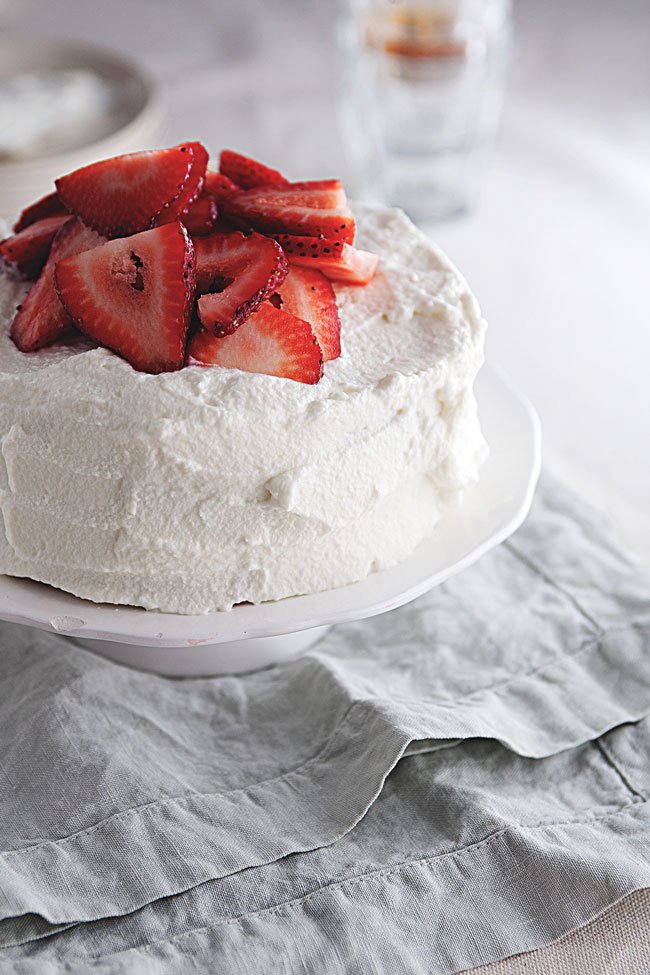
And finally, the fruit. The fruit is the pièce de resistance. There’s nothing Asian people (well, I can actually only speak for the Chinese) love more than fresh fruit, so they go a little crazy when they get to use it to embellish their cakes. Strawberries, grapes, kiwi, mango, it’s all arranged orderly, concentrically… and to quite cheesy effect, in my opinion, which is why I decided to just pile mine on and hope for the best. It does make slicing kind of annoying, but fresh strawberries are a must for that Pocky effect.
This recipe produces a spot-on cake. That’s all I can say. I was brought back to all those birthdays and other special occasions of my youth which always produced one of these lovelies by the end of the evening. Also, watch the video because the woman who runs the channel is really (really really) cute.
JAPANESE STRAWBERRY SHORTCAKE
Adapted from The Little Teochow, originally from Ochikeron (Youtube)
Ingredients: (take note, I’ve officially switched over to weight measurements!)
For the cake:
2 large eggs
60 grams sugar
60 grams cake flour (or, the same amount of all-purpose flour with 1 T replaced with corn starch), sifted a few times
20 grams butter, melted
For the simple syrup:
1.5 T hot water
1/2 T sugar
For the vanilla whipped cream:
1-1/4 cup heavy cream, cold
1 to 2 T sugar
1/4 t vanilla extract
1 lb. strawberries
Directions:
For the cake:
Butter a 6-inch baking pan and cut out a round sheet of parchment paper to fit on the bottom. Preheat the oven to 325 degrees F.
Beat the eggs and sugar over a bain marie (hot water bath) until the sugar melts and the mixture is warm, about room temperature. Remove the bowl from the water bath and beat the mixture on high until it triples in volume. (I used the bowl of my mixer, so I could transfer it easily to my stand mixer.) It will become very light and foamy and form a ribbon of batter when you take the whisk out. This should take about 5 minutes at speed 8 using my stand mixer. Reduce the speed to low for a minute or so to set the mixture.
Sift in the cake flour in three additions, each time gently cutting through the mixture with a whisk to mix the flour in. Sprinkle the butter into the bowl, and gently fold it in with a spatula. The batter should still be reasonably foamy.
Pour the batter into the baking pan, taking care to distribute it as evenly as you can. Rap the pan a couple times against your counter to eliminate any big air bubbles.
Bake 25 to 28 minutes until the center is set. Cool the cake upside down still in its pan on a baking sheet. Once it’s cool, slice it into two equal-sized rounds. Feel free to wrap it tight and store it at this point.
Assembling the cake:
Wash and prepare your strawberries. I sliced mine lengthwise, but you can also halve them, or whatever you’d like. Some of the strawberries will go in the inner layer of the cake, but the rest will top the cake decoratively, so keep that in mind.
Make the whipped cream by mixing the heavy cream, sugar, and vanilla extract and beating it until it forms soft peaks. (A few minutes on medium-high speed on my stand mixer. Take care not to overmix!)
Make the simple syrup by stirring together the sugar and hot water until the sugar has melted. Brush the syrup on the sliced side of one of the cake rounds. Spread a few dollops of whipped cream evenly on top, then place on top of that the sliced strawberries. Add another layer of whipped cream. Brush the rest of the syrup onto the sliced side of the remaining cake round, and place it over the whipped cream layer. Now you can “frost” the cake however you like, but since the whipped cream is pretty flimsy, don’t obsess over making the cake look perfect. I just spread it all over the surface of the cake and did my best not to get crumbs everywhere. Top with the remaining strawberries.
Serve and enjoy! I would recommend eating the whole thing right away, since it doesn’t save well in the fridge.
Is Sauerkraut Safe for Acid Reflux? Benefits and Risks

Sauerkraut, a popular fermented food made from cabbage, has been praised for its potential health benefits, including improving gut health, boosting the immune system, and offering a rich source of probiotics. As with any food, those dealing with acid reflux or gastroesophageal reflux disease (GERD) may be concerned about whether sauerkraut is safe to consume, given its acidic nature and fermentation process.
In this article, we will explore the effects of sauerkraut on acid reflux, the potential benefits, and risks of including sauerkraut in an acid reflux-friendly diet, and offer practical tips on how to incorporate it into your meals.
What is Sauerkraut?
Sauerkraut is made by fermenting finely chopped cabbage with salt, a process that promotes the growth of beneficial bacteria, or probiotics. This fermentation process not only enhances the flavor but also increases the nutritional value of the cabbage, providing a source of fiber, vitamin C, and various B vitamins.
The probiotics in sauerkraut, such as lactic acid bacteria, support digestive health by promoting a healthy balance of gut bacteria. This can improve digestion and immune function. However, as a fermented food, sauerkraut has a distinct tart, sour taste due to the lactic acid produced during fermentation.
Is Sauerkraut Acidic?
Sauerkraut’s acidic nature stems from the lactic acid produced during fermentation. As a result, sauerkraut has a low pH (usually around 3.0 to 3.5), making it acidic. This can raise concerns for individuals with acid reflux, as acidic foods may exacerbate the condition by irritating the esophagus and increasing acid production in the stomach.
However, the acidity of sauerkraut is not the only factor to consider when evaluating its impact on acid reflux. The presence of probiotics and other nutrients in sauerkraut may play a significant role in how it affects digestion and acid reflux symptoms.
Related to Read: Sauerkraut for Acid Reflux: A Tangy Delight or a Heartburn Trigger?
Sauerkraut and Acid Reflux: The Potential Benefits
While sauerkraut is acidic, it may offer several digestive health benefits that could help manage acid reflux symptoms for some individuals. Let’s explore how sauerkraut could be beneficial:
- Probiotics and Gut Health:
- Sauerkraut is a probiotic-rich food, meaning it contains beneficial bacteria that can improve gut health. Research has shown that a healthy gut microbiome can play a role in preventing and managing acid reflux. Probiotics may help balance the gut flora and promote better digestion, which could reduce the likelihood of reflux symptoms.
- Improved Digestion:
- The probiotics in sauerkraut help break down food more efficiently, reducing the burden on the stomach. This could lead to improved digestion, helping to prevent bloating, indigestion, and acid reflux symptoms. Sauerkraut can also support overall gastrointestinal health, contributing to smoother digestion.
- Anti-Inflammatory Effects:
- Sauerkraut contains antioxidants and compounds that may help reduce inflammation in the digestive tract. Chronic inflammation in the esophagus is a key factor in acid reflux and GERD. By reducing this inflammation, sauerkraut might provide some relief for those with acid reflux.
- Alkalizing Effect After Digestion:
- Although sauerkraut is acidic in nature, fermented foods can have an alkalizing effect on the body once digested. This means that after the fermentation byproducts are processed, the body may experience a reduction in acidity, which could benefit those with acid reflux.
Author Tip: 7 Kinds of Foods to Avoid with GERD
Sauerkraut and Acid Reflux: The Potential Risks
While sauerkraut offers several digestive health benefits, it may not be suitable for everyone with acid reflux. Here are some potential risks to keep in mind:
- High Salt Content:
- One of the primary concerns with sauerkraut for individuals with acid reflux is its high salt content. Too much salt can contribute to water retention and high blood pressure, and may also irritate the stomach lining. Some people with acid reflux may be sensitive to salty foods, which could worsen symptoms like bloating and indigestion.
- Fermented Foods and Gas Production:
- Sauerkraut contains fiber and fermented sugars (oligosaccharides), which can produce gas during digestion. For some individuals, this may lead to bloating, discomfort, and increased pressure on the stomach, which could trigger acid reflux or worsen existing symptoms.
- Acid Sensitivity:
- While sauerkraut may be beneficial for some, its acidic nature might aggravate symptoms in others. If you are sensitive to acidic foods, sauerkraut could potentially worsen acid reflux by increasing stomach acidity or irritating the esophagus.
- Portion Control:
- Consuming large amounts of sauerkraut in one sitting could potentially lead to indigestion or exacerbate acid reflux symptoms. Moderation is key when incorporating sauerkraut into your diet.
How to Include Sauerkraut in an Acid Reflux-Friendly Diet?
If you have acid reflux but would like to try incorporating sauerkraut into your meals, here are some practical tips:
- Start with Small Portions:
- Begin with small amounts of sauerkraut to see how your body reacts. If you experience any discomfort, it may be best to reduce your intake or avoid it altogether.
- Choose Low-Sodium Sauerkraut:
- Look for low-sodium or homemade sauerkraut options to reduce the amount of salt in your diet. Excessive salt can aggravate acid reflux symptoms.
- Pair Sauerkraut with Alkaline Foods:
- If you’re concerned about the acidity of sauerkraut, pair it with alkaline foods like leafy greens, cucumbers, or bananas. This can help balance out the acidity and create a more reflux-friendly meal.
- Avoid Sauerkraut on an Empty Stomach:
- For some people, eating sauerkraut on an empty stomach might trigger acid reflux symptoms. Try consuming it with other foods to reduce the likelihood of irritation.
Author Tip: 7-Day Meal Plan For Gastritis
Scientific Research on Sauerkraut and Acid Reflux
While there is limited specific research on the effects of sauerkraut on acid reflux, studies on fermented foods and probiotics provide some insight:
Study 1: Probiotics and GERD A study published in the World Journal of Gastroenterology suggests that probiotics may help manage symptoms of acid reflux and GERD. Probiotics improve gut health and digestion, which could lead to fewer reflux episodes. As sauerkraut is rich in probiotics, it could potentially support these benefits.
Study 2: Effects of Fermented Foods on Digestion Research has shown that fermented foods like sauerkraut can support digestion by introducing beneficial bacteria into the gut, which aids in the breakdown of food. This could help reduce digestive discomfort and prevent the build-up of stomach acid, a key contributor to acid reflux.
Conclusion
So, is sauerkraut safe for acid reflux? The answer depends on your individual sensitivity to acidic foods and your overall digestive health. While sauerkraut’s acidic nature and high salt content might trigger reflux symptoms in some individuals, its probiotic-rich composition can offer potential benefits for others by promoting better digestion and a balanced gut microbiome.
If you have acid reflux, it’s best to start with small amounts of sauerkraut and pay attention to how your body reacts. Choosing low-sodium varieties and pairing sauerkraut with other alkalizing foods can help make it a more reflux-friendly option.
As always, consult with a healthcare provider before making any significant changes to your diet, especially if you have chronic acid reflux or GERD.